The Small, Often Invisible Moments That Matter
Caleb Johnston connected with Georgetown’s Prisons and Justice Initiative (PJI) through a practicum requirement in the Master of Arts in American Government program at the Graduate School of Arts & Sciences. A conversation with his program directors pointed him toward PJI, and he hasn’t looked back since.
Johnston currently supports reentry services as part of a team led by Director of Reentry Services Tyrone Walker. His day-to-day work includes supporting students returning from incarceration, coordinating with nonprofit partners, assisting with reentry programming, and helping keep the office’s daily operations running smoothly. “Even when it feels like I’m not doing anything ‘super important,’ I know I’m helping facilitate a really good cause that’s doing meaningful work,” Johnston said.
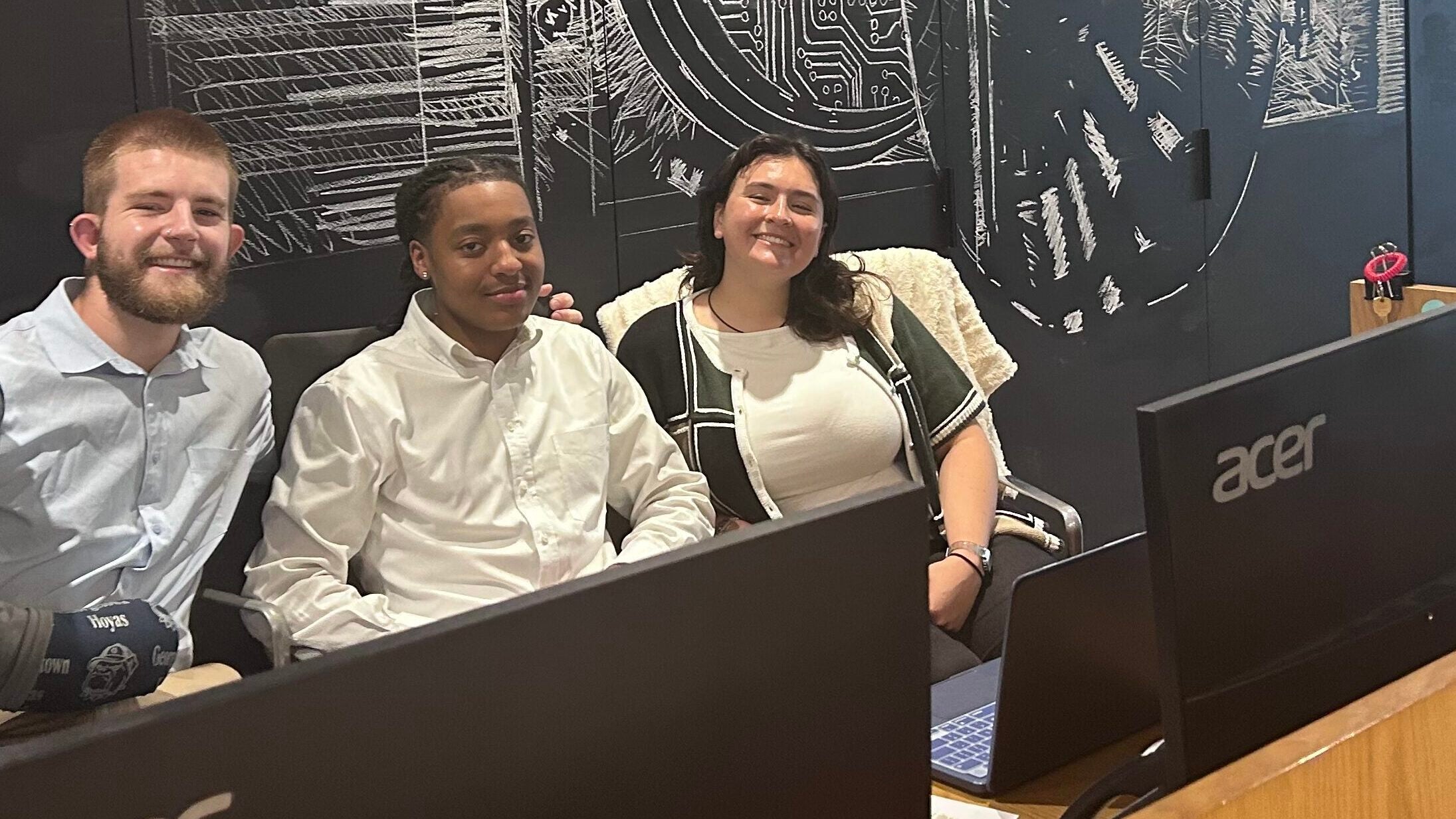
Left to right: Caleb Johnston, Amari Jones, and Julia Rasmussen at the PJI office.
That sense of purpose deepened through his conversations with Walker, particularly one exchange that reshaped how Johnston thinks about reentry. “A conversation with Tyrone opened my eyes to how reentry struggles show up in everyday tasks, like riding public transit. High-traffic, crowded spaces can trigger post-traumatic stress symptoms, which means the challenges of coming home are baked into the most mundane parts of daily life,” he said. Hearing that helped Johnston see how trauma-informed support has to extend far beyond the big, obvious moments.
Before starting at PJI, Johnston’s view of the PJI’s work was limited. Once involved, he realized how much broader the scope really is: how PJI connects people in the Pivot or MORCA-Georgetown Paralegal Programs with recovery support, how the organization coordinates reentry services, and how it operates across education, wrongful-conviction advocacy, and day-to-day reentry work. “I had totally underestimated the full scope of what they do; they really do have their hands in everything, and the less flashy programs are just as impactful as the ones that get media attention,” he remarked.
Working with PJI has also shaped the conversations Johnston has with friends, family, and other Georgetown students who don’t have direct exposure to the criminal legal system. “A common assumption I encounter is that criminality is somehow inextricably linked to the person, that it is who they are, rather than something in their history,” Johnston said. “You can hear that in the language people use: saying ‘criminals’ instead of ‘people with criminal histories,’ or ‘prisoners’ instead of ‘people who are incarcerated.’ Through my time at PJI, I’ve become much more perceptive about how language reflects stereotypes and how people get reduced to their incarceration status when there is so much more to them as human beings.”
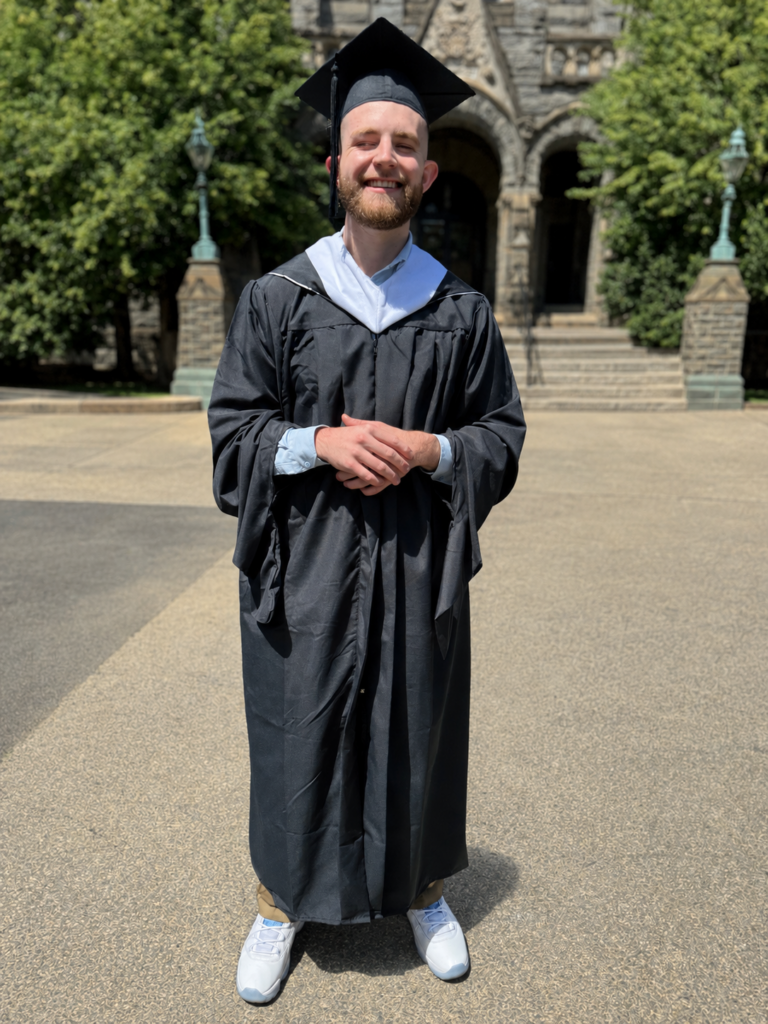
Caleb Johnston smiles for a photo after graduation.
Because of all this, Johnston thinks a lot about what kinds of stories would help other students and the broader Georgetown community really understand PJI’s full impact. The big headline moments, like exoneree stories, are important, but they don’t show the culture. He’d love people to see more of the normal day-to-day life: the way staff and students greet each other in the hallway, the smiles, the waves, the casual check-ins that create a positive atmosphere.
Reflecting on his experience thus far at PJI, he said, “Overall, this experience has made me more aware, more careful with my language, and more committed to centering the everyday realities of reentry – the small, often invisible moments – where support and dignity matter just as much as in the big, public wins.”