Williamz Diaz-Salamanca on Second Chances, Growth, and Making His Mother Proud
“Life-changing.”
With one word, Williamz Diaz-Salamanca summed up his experience in Georgetown University’s Bachelor of Liberal Arts (BLA) program. In 2023, Diaz-Salamanca joined the third cohort of the BLA program after completing a rigorous application process that also included interviews with Georgetown staff and faculty. When Diaz-Salamanca received the acceptance letter, he quickly understood how rare the opportunity was, as many applicants housed in his unit were not admitted to the program. Incarcerated since he was 19 years old, the idea of pursuing a college education once felt far out of reach.
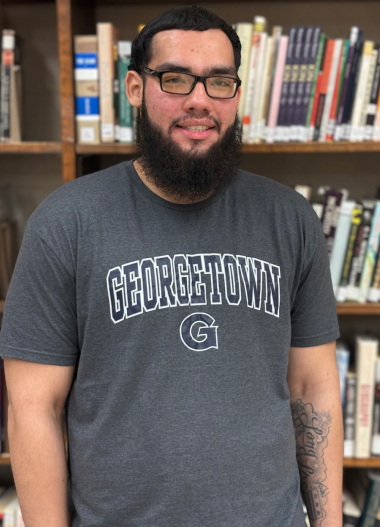
Williamz Diaz-Salamanca in the library at Patuxent Institution.
The acceptance letter from Georgetown University changed that. As proud as he was of himself, he knew his family would be even prouder. The person he was most excited to tell was his mother. “I think it meant more to my mom than it did to me,” Diaz-Salamanca joked, reflecting on her joy. “Nothing can beat making my mom proud.”
Now in his mid-20s, Diaz-Salamanca reflects on how far he has come. Proudly born into an immigrant family, he is a first-generation college student who strives to set an example for his younger siblings, even while navigating the challenges of incarceration. The example he and his classmates set extends beyond the Georgetown classrooms and into the halls of the correctional facility’s education department. “A lot of students in other programs, like the GED program, look up to us,” he said. “They see what is possible when they see us, and that is motivating.” Dr. Amanda Lewis, Research Associate and Adjunct Professor in the BLA Program, said Diaz-Salamanca plays a key role in keeping class discussions dynamic. “He consistently produces thoughtful work and helps foster a classroom environment that is welcoming, engaged, and grounded in care for others,” she said.
Diaz-Salamanca takes pride in being a Georgetown student and the significance that carries, even within a carceral setting. “To be a part of the program, there is a high expectation,” he said. “When you walk into the BLA students’ tier [on the housing unit], you see people studying. Books are everywhere. People are writing papers. You don’t see violence.” Diaz-Salamanca noted that the reason is very simple: everyone in the program shares a common goal of pursuing an education, and that commitment is not taken for granted.
He also credits the Georgetown staff and faculty, as well as the correctional officers, for creating an atmosphere where students can simply be students. “The Georgetown staff is amazing. I don’t know anyone who would willingly come into a prison,” he said. “They really see us as Georgetown students.” He said that same sense of respect is reflected throughout the correctional facility. “They see our dedication to the program,” he said.
Before joining the BLA program, Diaz-Salamanca planned to pursue auto care, a skill he had always excelled in. However, since joining the program and learning about new possibilities, his aspirations have shifted. “It had a lot to do with the fear of the unknown. Auto was what I knew,” he said. “Now, I plan to pursue something in the liberal arts. The program has planted a seed for different levels of possibility that I never thought of.”
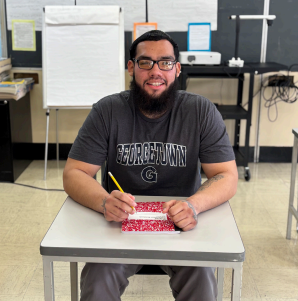
Williamz Diaz-Salamanca pauses for a moment before class starts.
When asked about the importance of the BLA program, Diaz-Salamanca did not hesitate. “It gives people hope that they are beyond their mistakes. It shows that, when given the opportunity, education can help a person change and grow. We are not the same people we once were.”
This article is featured in the 2025 Prisons and Justice Initiative Annual Report. Read the full report here.